Persistent Autonomy
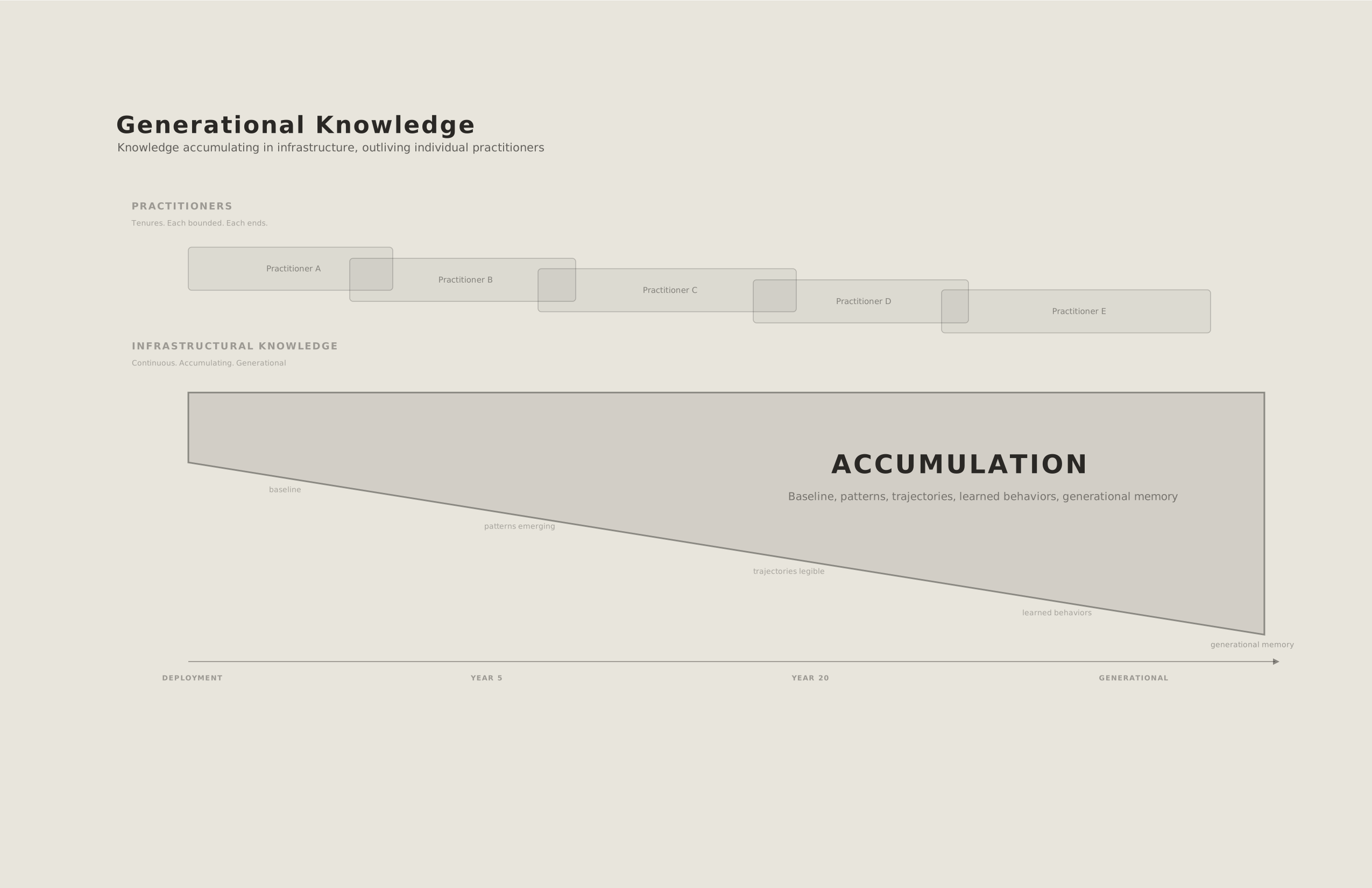
Adaptive epistemology requires learning across timescales that exceed any individual career, any institutional memory, any funding cycle. No human practitioner can span those timescales. This chapter proposes that generational robots, machines designed for habitat persistence rather than task completion, are the infrastructural answer to that temporal problem, not a fantasy but a trajectory already underway in environmental monitoring and conservation.
This chapter develops from a provocation I published eight years ago. “Designing Autonomy: Opportunities for New Wildness in the Anthropocene”, written with environmental historian Laura J. Martin and geographer Erle C. Ellis, and published in Trends in Ecology & Evolution in 2017, proposed that maintaining wild places in the Anthropocene paradoxically requires increasing levels of human management, and that this paradox might be resolved through fully automated systems capable of creating and sustaining wildness without ongoing direct human involvement. The paper introduced a conceptual design for a “wildness creator”, an autonomous landscape infrastructure system whose operations would eventually become “unrecognizable and incomprehensible to human beings,” producing ecological patterns divergent from anything humans had created (Cantrell, Martin, and Ellis 2017).
The paper was deliberately speculative. It surveyed eight existing semi-autonomous environmental management systems, from Oostvaardersplassen’s rewilding through surrogate megafauna to COTSbot’s autonomous removal of invasive crown-of-thorns starfish, and proposed that deep reinforcement learning systems, learning conservation strategies through environmental interaction rather than following pre-programmed rules, represented a viable extrapolation of trajectories already underway. But the paper left underspecified a set of questions that have become increasingly pressing as autonomous systems have matured. What is the temporal structure of a robotic system designed for generational operation? How does slow persistence change the epistemological character of what such systems can know? What does it mean to design landscapes that are maintained by systems whose decisions cannot be fully audited or understood?
This chapter takes those questions seriously. It draws on the robot ecology framework developed by Magnus Egerstedt, whose survivability constraints and habitat-centric design principles provide the engineering rigor that the Designing Autonomy paper gestured toward, to develop a more complete account of what generational robots would need to be, what they would need to know, and what landscape architecture’s role in designing their territories and ecologies might look like. The answer begins with an inversion, not speed but slowness.
Why Slowness Matters Now
The dominant cultural image of robots is still one of speed, expressed as agile quadrupeds sprinting across rubble, drones streaking through canyons, assembly arms flickering faster than the human eye. Speed has become synonymous with capability, and capability with value. But when we turn to environmental monitoring and landscape stewardship, speed is often a harmful temporal register. Forest dynamics, groundwater shifts, permafrost thaw, or coastal subsidence unfold over months, years, and generations. A robot that can sprint for twenty minutes is far less useful than one that can drift, amble, or hang motionless for years.
This temporal mismatch reveals something deeper about the relationship between speed, perception, and knowledge. Fast observation produces facts, discrete data points captured at high frequency, snapshots frozen in time. Slow observation produces something different, it produces possibility. Extended presence allows patterns to emerge, relationships to become legible, trajectories to unfold. The difference is not merely quantitative but epistemological. Fast sensing confirms or refutes hypotheses. Slow sensing generates them. Fast data closes questions. Slow data opens them.
Speed also determines the quality of interaction between observer and observed. A drone passing overhead at forty kilometers per hour captures an image but establishes no relationship with the landscape below. A robot dwelling in a marsh for months becomes entangled with that marsh and its movements synchronized to tidal rhythms, its energy budget coupled to solar angles, its sensors calibrated to the particular chemistry of that water. This entanglement is not contamination but the condition of co-habitation. The observer becomes part of the system observed, and that participation transforms what can be known.
This is the premise behind thinking about slow robots as a form of environmental infrastructure. Rather than one-off tools for short campaigns, these systems are conceived as enduring inhabitants of a landscape, moving just enough to track gradients, harvest energy, avoid hazards, and maintain vantage points, but otherwise tuned to the long rhythms of the systems they observe. In robotics, this shift shows up as a move from tasks accomplished over hours to long-duration autonomy as the core design objective. Magnus Egerstedt’s work on robot ecology formalizes this as a control problem in which robots must satisfy survivability constraints (maintaining energy, health, and safety) over open-ended time horizons, rather than simply reaching a stated goal (Egerstedt 2021). Slowness becomes a strategy and by moving less, consuming less, and accepting lower task throughput, robots can remain present long enough to matter for ecological processes.
Slowness also provides something that speed forecloses, a space for consideration. A fast agent reacts, a slow agent responds. The difference is consequential. Reaction is automatic, determined by pre-programmed thresholds and decision trees. Response involves interpretation, weighing, adjustment, a form of deliberation that unfolds in and requires time. When robots dwell rather than dash, they create temporal room for input from other agents, for evolution of conditions, for adaptation of strategies. They become participants in ecological time rather than interrupters of it.
At the landscape scale, this repositions robots from episodic visitors, like field crews, to something closer to resident species performing as agents with niches, diets, and temporalities that must be matched to the environments they inhabit. That ecological lens opens up a different set of design questions. How do robot populations share scarce recharging sites? How do they avoid over-exploiting their own habitats of energy and data? How do they coexist with, or even support, nonhuman organisms?
From Fast Agents to Robot Ecologies
Traditional robot design has followed a task-centric paradigm to design a robot capable of completing a job under expected conditions and evaluate success by task completion. In this mindset, the world is largely a backdrop and once the mission is done, the robot returns to a charging dock, a lab, or a scrap heap. The temporal horizon extends only to task completion, and success is measured in speed and efficiency.
Robot ecology inverts this framing. Instead of starting from a task, it starts from a habitat and asks what kinds of robotic agents could persist there over long durations, satisfying their survivability constraints while contributing a useful service (Egerstedt 2021). This ecology-inspired view emphasizes constraints over goals. Safety, energy, and health constraints must always hold, while task-related objectives such as coverage, data yield, or inspection frequency are pursued only within the space those constraints allow.
The shift from task to habitat transforms the temporal structure of robotic attention. Task-centric robots experience time as a countdown, a depleting resource to be optimized against mission objectives. Habitat-centric robots experience time as a medium, as an envelope within which presence, observation, and response unfold. This reframing changes what robots can perceive and know. The countdown (fast) perspective privileges facts with discrete measurements captured before the clock runs out. The medium (slow) perspective enables patterns to reveal relationships that only become visible through extended dwelling.
Robot ecology also shifts attention from individuals to populations. Long-duration autonomy is often easier to achieve with a population of robots that can distribute load, share resources, and compensate for failures than with a single heroic machine. Finally, it privileges niches over generic platforms, recognizing that robot ecologies benefit from specialized forms such as arboreal robots for canopy sensing, benthic crawlers for sediments, gliding autonomous underwater vehicles for the water column, and slow ground rovers for soil and vegetation.
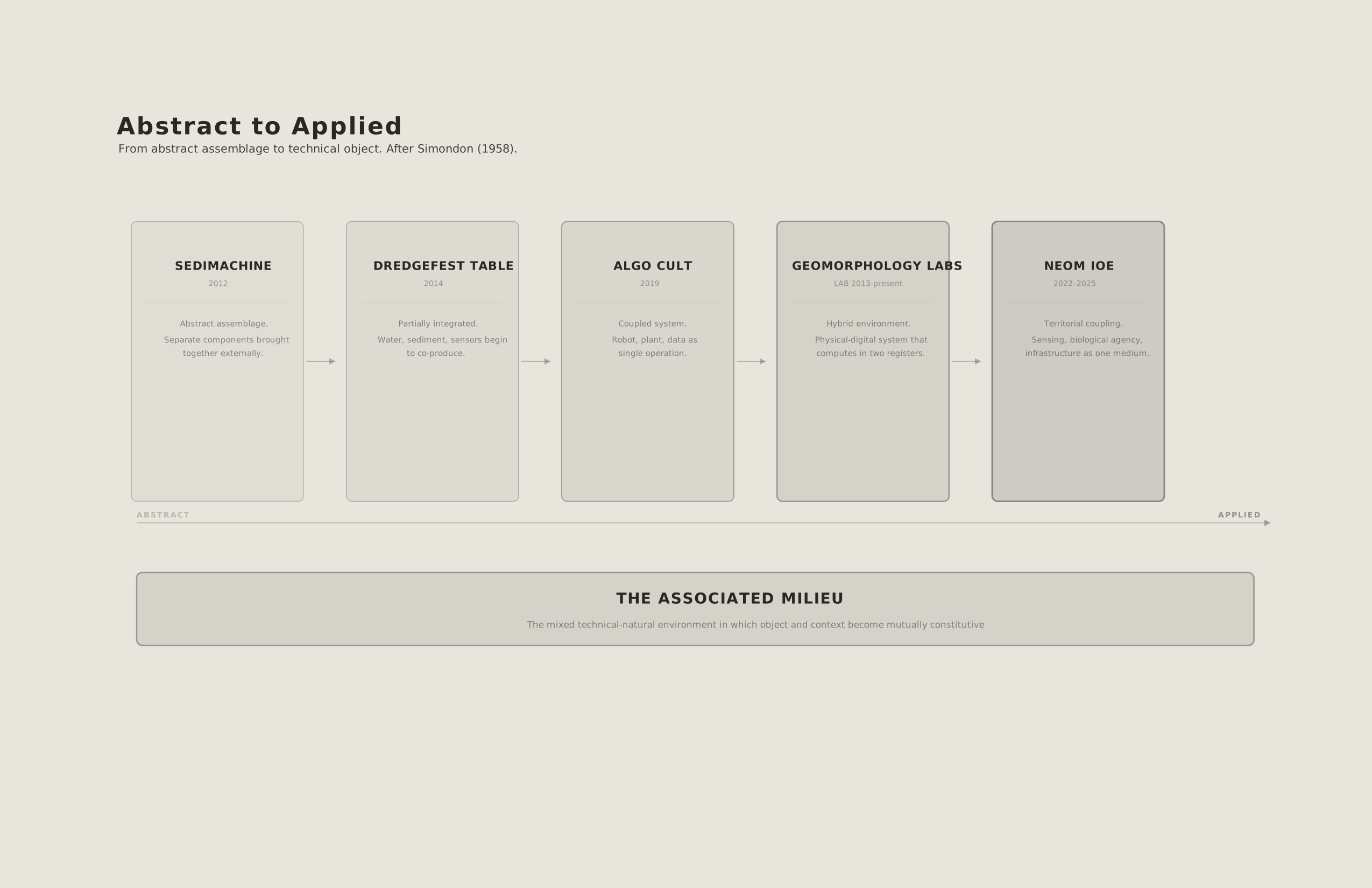
The geomorphology modeling research conducted at the UVA (2017–present) provides a practice-based account of this transition from task-centric to habitat-centric design. The geomorphology table, a physical-digital hybrid environment of synthetic sediment, programmable water flow, and multi-modal sensing, was deployed initially through direct interaction, researchers physically placed objects, adjusted slopes, introduced sediment mixes, and observed outcomes. The system then moved toward responsivity, actuated sediment gates, sieves, and flow disruptors were programmed to react to sensed conditions, adjusting gate sequences based on detected sediment accumulation patterns. The research frontier at UVA moves toward the third mode, autonomy, how might the sediment gates develop response patterns through machine learning rather than pre-programmed rules?
The analogy is precise. A traditional thermostat operates through fixed threshold rules, when temperature drops below X, activate heating. A Nest thermostat develops patterns of automation through machine learning, optimizing across user schedule, energy pricing, and thermal dynamics, developing behaviors unique to the learning algorithm and the context in which it functions (Cantrell and Holzman 2016). The UVA research asks the equivalent question for sediment infrastructure, how might a gate system that learns from its own interactions with flow and deposition develop response patterns that a human designer could not have specified in advance? And what are the consequences, epistemological, ecological, ethical, when it does?
This gradient from interaction through responsivity to autonomy is not merely theoretical. It is a research trajectory the lab has been advancing for eight years, at experimental scale, before territorial deployment. The robot ecology framework that Egerstedt formalizes provides the vocabulary for understanding what each transition requires, the move from responsivity to autonomy demands not only different algorithms but different relationships between the robot and its habitat, longer time horizons, survivability constraints rather than task completion metrics, and the acceptance that the system’s behavior will evolve in ways its designers cannot fully predict or control.
Fast computation applied to slow ecological systems within a predictive frame produces a specific pathology. The algorithm responds at computational speed to processes that unfold across seasons and decades. Interventions adjusted daily on the basis of short-term fluctuations prevent slower processes from reaching the states that would have generated the most valuable knowledge. The system is managed into a narrow performance envelope that looks healthy on the dashboard while the biological community’s capacity to explore, to reorganize, to develop configurations no model anticipated, is progressively constrained. Generational robotics is designed against this pathology. Slowness is not a limitation. It is the temporal condition under which the territory’s own intelligence becomes legible.
This thinking is visible in the design of SlothBot, a wire-traversing robot developed to monitor environmental conditions in botanical gardens and forests. SlothBot hangs from cables, creeps slowly between trees, and relies on solar panels to harvest enough energy to remain operational for months. Slowness, in this case, is not a limitation but a carefully chosen adaptation to sparse energy and the need for low-disturbance presence in sensitive habitats (Egerstedt and Pauli 2020). The same logic underpins robotic concepts for persistent environmental monitoring and management in other domains. Long-range autonomous underwater vehicles (LRAUVs) designed for weeks-long scientific missions at sea prioritize energy efficiency, reliability, and the ability to dock, recharge, and re-task autonomously over dynamic performance (Ben-Yair et al. 2015).
Across these examples, robot ecology insists that we treat the robot-environment coupling as a mutual constraint satisfaction problem. The robot must satisfy its own survival constraints while remaining embedded in, and responsive to, the dynamics of the environment it inhabits.
Environmental Sensing as Robotic Habitat
Slow robots only make sense against the backdrop of rapidly evolving environmental sensing technologies. As sensor costs drop and power requirements shrink, the possibility of embedding dense networks of micro-sensors into landscapes, on posts, trees, buoys, building facades, or animal collars has expanded dramatically (Chan et al. 2020).
Two developments are particularly important for robot ecologies. First, low-cost, low-power sensing built on open-source platforms makes it possible to deploy large numbers of inexpensive sensors, provided calibration and drift are carefully managed. This democratizes data collection, enabling citizen science and distributed monitoring, but also produces new problems of data quality and standardization. Second, onboard computation and AI-enabled calibration allow machine learning models to correct biases and environmental interferences in low-cost sensor outputs, effectively bringing cheap hardware into research grade performance when coupled with reference data (Barcelo-Ordinas et al. 2022).
From a robot-ecology perspective, these trends mean that much of the environment is becoming a potential sensor substrate because robots are mobile and power-rich relative to static nodes and therefore can carry higher-quality instruments or serve as roving calibration platforms. In this emerging arrangement, robots and static sensors form complementary layers of an environmental nervous system. Static nodes provide continuous, localized time-series data, while slow robots weave among them, collecting more detailed measurements, cross-checking sensor readings, and filling spatial gaps. Edge computing on both nodes and robots allows “just enough” processing close to where data is produced, reducing bandwidth and enabling localized alerts.
The interaction between fast sensing and slow movement produces a particular mode of knowledge. Static sensors capture rapid fluctuations, the fast facts of momentary conditions. Mobile robots, moving slowly through sensor networks, integrate these facts across space and time, transforming discrete measurements into relational understanding. A temperature spike at one sensor becomes meaningful when the robot, having visited neighboring sensors, can situate it within a spatial gradient. A salinity reading becomes significant when the robot’s trajectory through time reveals whether conditions are trending toward or away from thresholds. The slow robot is not simply collecting data, it is also composing data into knowledge through the temporal structure of its attention.
A forest, for instance, might be equipped with a sparse grid of low-cost humidity and temperature sensors attached to tree trunks, while a wire-traversing robot moves slowly above the canopy, carrying more precise instruments, performing periodic calibration visits, and repositioning itself to chase anomalies. In short, environmental sensing turns landscapes into robot habitats where energy, data, and connectivity are spatially structured resources that robots must navigate and manage.
Algorithmic Cultivation (2019) encountered the generational robot problem in miniature, before the problem had a name. The robotic system was designed to operate for a year, the plants responding through growth configurations that the pruning would have incrementally shaped, the response becoming the input for subsequent pruning decisions. Technical difficulties limited the installation’s operation to weeks.
The failure is instructive in ways that success would not have been. Maintaining the coupled assemblage, keeping the robot’s sensing equipment calibrated in a humid growing environment, sustaining the data feeds, ensuring institutional support for an installation that would not resolve into a completed object, proved demanding in proportion to the biological agency the system was designed to cultivate. A simpler optimization-oriented system, programmed to maximize plant yield through precisely targeted irrigation and fertilization, would have been easier to maintain, its biological substrate was performing a specified role, not exploring one. The difficulty scaled with the degree to which the wetware was treated as a genuine participant.
Scaled to generational timeframes and territorial landscapes, these difficulties become the primary design problem. A slow robot dwelling in a marsh for years faces the Algorithmic Cultivation problem continuously, biofouling, sensor drift, component fatigue, and the biological dynamics of the environment it inhabits, which do not pause for maintenance cycles. The design priorities this chapter identifies, energetics as primary driver, reliability in the face of long-term exposure, quiet low-impact mobility, are not engineering preferences but responses to the specific failure modes that the Algorithmic Cultivation installation made visible at small scale. The installation’s truncated operation is the evidence base for why persistent presence is harder to achieve than it appears in speculation, and why the design of energetics, reliability, and maintenance protocols is as important as the design of sensing and actuation.
Slow Robots as Infrastructure
When slow robots are designed to remain in place for years, repeatedly traversing the same networks of wires, trails, currents, or air corridors, they begin to resemble infrastructure more than tools. Egerstedt describes this as treating robots as “persistent resources” embedded into the fabric of an environment rather than as disposable, mission-specific instruments (Egerstedt 2021). Thinking of robots as infrastructure highlights their persistence, dependability, and publicness.
Persistence means that the value of the system comes from continuous or regular presence, evident in always-on ocean gliders, canopy robots that never leave, barn guardians that monitor air quality around the clock. This persistence produces a form of temporal magnification that performs as an amplification of moments that would otherwise pass unregistered. A sensor that samples once per hour captures 8,760 measurements per year, a slow robot dwelling in the same location captures not just measurements but the texture of change between them, the rhythms and ruptures that constitute environmental time. Each moment is magnified because it exists within a continuous field of attention rather than as an isolated sample.
Dependability means that, like a bridge or a fiber-optic cable, a slow robot must be trusted to function in the background and that failure and maintenance cycles must be understood and planned for (Wang et al. 2019). Publicness, finally, acknowledges that many of the most consequential applications of climate monitoring, flood early warning, habitat surveillance have the character of public goods. Over time, persistent robots also develop a charismatic presence, becoming familiar features of the landscapes they inhabit and the species they share them with.
Examples of this infrastructural turn are appearing across domains. In agriculture, autonomous ground vehicles now crawl through fields carrying multi-parameter sensor suites, mapping moisture, temperature, and gas concentrations over large areas at fine spatial and temporal resolution. For tasks like seeding and weeding, robots reduce fuel use and operating costs compared to conventional machinery while enabling more precise environmental control (Tsanakas et al. 2023). In oceanography, fleets of LRAUVs and gliders, some able to dock autonomously at underwater stations, act as persistent sentinels of biogeochemical change, oil spills, and storm impacts, extending human observation into depths and durations that would otherwise be prohibitively expensive or dangerous (Ben-Yair et al. 2015). In forestry, platforms like SlothBot and newer wire-traversing robots such as RaccoonBot demonstrate how slow arboreal systems can instrumentalize tree canopies over long periods while relying on ambient energy and minimal human intervention (Pauli et al. 2020; Scherbat et al. 2025).
Across these cases, slowness is linked to energy autonomy and low disturbance. By minimizing motion and leveraging ambient energy (solar, wave, thermal, or even microbial fuel cells) slow robots can turn tenuous energy flows into operational lifetimes measured in months or years rather than hours (Pinto et al. 2019). For landscape architecture, conceiving of robots as infrastructure invites us to imagine corridors, nodes, and “robot-friendly” microarchitectures (gantries, mooring points, charging refuges) that are designed not just for human use, but for robot dwelling and circulation as well.
Designing for Slowness
Energetics, Reliability, and Quiet Mobility
If fast robots are engineered around actuation bandwidth and reaction speed, slow robots are engineered around energy budgets and failure modes. Three intertwined design priorities dominate, energetics as a primary driver, reliability in the face of long-term exposure, and quiet, low-impact mobility.
Energetics comes first. In robot ecology, energy is the ultimate limiting resource. Control policies are designed not only to achieve coverage or data collection objectives, but also to ensure that robots never violate survival constraints in that they must reach charging sites, stay within safe battery limits, and avoid behaviors that drain energy too quickly (Notomista and Egerstedt 2019). Slowness helps on multiple fronts. Lower actuation costs mean that moving slowly reduces dynamic losses and allows for lighter drive systems. Alignment with environmental processes means robots can dwell under sunlight, float in high-energy currents, or linger over microbial fuel cell patches, matching their duty cycles to ambient energy flows. Temporal flexibility, finally, reflects the fact that, because slow robots are not rushed to complete short missions, they can afford to pause in “feeding zones” to recharge. This is evident in systems like SlothBot, whose intermittent, deliberate movements are choreographed around solar charging cycles, and in LRAUV missions that plan sinuous, low-drag trajectories synchronized with ocean currents and docking opportunities (Pauli et al. 2020; Ben-Yair et al. 2015).
This energy-driven temporality creates a distinctive relationship to environmental time. Fast robots impose their schedules on landscapes where slow robots synchronize their schedules with landscapes. The sun rises, and the robot can move. Clouds gather, and the robot waits. This negotiation is not a limitation but a form of coupling and the robot’s rhythm becomes entrained to environmental rhythms, and this entrainment produces knowledge that speed would preclude. The robot learns, through its own energetic constraints, the temporal structure of its habitat.
Reliability emerges as the second priority. As robots stay in the field longer, failures cease to be isolated glitches and become systemic risks. Component fatigue, biofouling, sensor drift, and software bugs accumulate. Experience from long-lived service robots like TritonBot, deployed as a receptionist and tour guide, demonstrates that reliability engineering (health monitoring, fault diagnosis, and graceful degradation) is a major issue for long-duration autonomy (Wang et al. 2019). For environmental robots, the ecology metaphor suggests two complementary strategies. One is individual robustness where critical components are over-engineered, operating envelopes are kept conservative, and self-diagnostic and self-maintenance behaviors are incorporated, allowing robots to clean sensors, recalibrate, or switch to safe modes. The other is population redundancy where designers accept that individual robots will fail, but design the population to maintain function through overlapping coverage, role flexibility, and ease of replacement. Resilience is achieved not only through hardened hardware, but also through ecological design of robot communities.
Quiet mobility, the third priority, has ecological advantages. Slowness reduces disturbance to wildlife, decreases erosion, and lessens the chance of collisions or entanglement. Early field deployments of mobile robots in barns and poultry houses demonstrate that animals habituate to repeated, predictable movements of robotic platforms, integrating them into their behavioral routines (Berckmans 2017). For robots sharing space with sensitive species, deliberate, low-impact mobility will be as important as measurement capacity. In robot ecologies, behavioral compatibility with nonhuman inhabitants becomes a design criterion alongside energy and data.
Active Sensing and Robot Ecologies
Static sensors measure whatever happens to pass by, robots can choose where and what to measure. When combined with long-duration presence, this ability enables forms of active sensing that go beyond simple patrols.
In environmental monitoring, active sensing has emerged as a way to maximize information gain under constraints of time, energy, and communication. Gaussian process models, for example, allow robots to estimate spatial fields such as temperature, pollutant concentration, or algal density, and then select the next best measurement locations to reduce uncertainty (Chen et al. 2013). Recent work demonstrates how reinforcement learning and Bayesian optimization are being woven into active sensing strategies, especially for multi-robot teams exploring dynamic environments (Shi et al. 2024; Li et al. 2025).
Bringing this into robot ecology reframes active sensing as a kind of foraging behavior. Robots “graze” on information, moving toward regions where their marginal contribution to knowledge is highest. They must constantly balance exploitation, the intensive sampling of known hotspots, with exploration searching for new phenomena. Their movement patterns begin to resemble those of animals tracking patchy resources, subject to metabolic or energy constraints.
This foraging produces a distinctive epistemology. Fast surveys generate maps, comprehensive but static representations of spatial distributions at a moment in time. Slow foraging generates narratives of trajectories through space and time that reveal how conditions develop, how anomalies emerge, how systems transition between states. The slow robot’s knowledge is inherently temporal, and it cannot be extracted from any single snapshot but emerges from the accumulated experience of dwelling. This is knowledge as possibility rather than fact which is open to revision, sensitive to context, productive of questions rather than answers.
Over long periods, a population of slow robots may collectively learn seasonal routines, visiting wetlands during algal bloom seasons, patrolling particular ridges during fire season, or focusing on urban canyons during temperature inversions. These emergent patterns, encoded in protocols rather than static schedules, constitute a kind of robotic phenology that can be tuned and revised as conditions change.
For landscape architects and environmental managers, this opens up a different relationship to monitoring. Instead of specifying fixed transects or sample points, they can set high-level objectives and watch as the robot ecology organizes its own routines to meet them.
Multi-Robot Ecologies
Niches, Mutualisms, and Division of Labor
Robot ecology becomes most compelling when we think not of single devices but of robotic communities. Egerstedt’s framework highlights how different agents (ground rovers, aerial drones, underwater gliders, canopy climbers) can occupy distinct niches, each with its own diet (energy source), sensory capabilities, and mobility constraints (Egerstedt 2021). Within such communities, classic ecological relationships can be reinterpreted.
Mutualistic relationships appear when one type of robot provides a service that directly benefits another, and vice versa. For example, a solar-powered surface robot might act as a charging buoy for smaller underwater robots, in return, the underwater robots share subsurface data that improve the surface platform’s own decision-making about where to linger or move next (Song et al. 2021). Commensalism can describe arrangements where small low-power robots rely on the communication infrastructure provided by larger, more capable platforms, gaining connectivity without significantly affecting their hosts. Competition emerges when robots with overlapping sensing roles vie for access to scarce recharging stations, bandwidth, or other critical resources, requiring coordination protocols to avoid harmful interference.
These relationships are not just metaphors, they can be formalized as constraint-based control problems in which each agent’s behavior is governed by its own survivability constraints, task objectives, and coupling terms that encode cooperation or competition (Notomista and Egerstedt 2019). For environmental monitoring, multi-robot ecologies are particularly powerful when different modalities are needed. In a coastal wetland, a mix of fixed stations, slow rovers, and occasional aerial overflights can combine detailed process measurements with broader synoptic views. Rather than deploying separate, uncoordinated systems, a robot ecology approach treats these as interdependent species, co-designed to share energy, data, and infrastructure.
The temporal diversity of multi-robot ecologies amplifies their epistemic capacity. Fast-moving drones capture facts in the form of synoptic views, rapid assessments, and emergency responses. Slow-dwelling robots cultivate possibilities of emerging patterns, developing anomalies, gradual transitions. Together, they produce a layered understanding that neither could achieve alone where facts are situated within trajectories, snapshots contextualized by narratives.
When different robotic modalities produce conflicting accounts of the same patch of territory, that divergence is not a calibration problem to be resolved. It is the most valuable data the multi-robot system produces. A ground rover’s salinity reading that conflicts with an aerial drone’s NDVI reading of the same marsh is the territory communicating in two registers simultaneously. The chemistry of the water is saying one thing, the vegetation health is saying another, and the gap between them is where the most interesting ecological process is happening. Multi-robot ecologies are specifically designed to generate productive divergence of this kind, to hold multiple accounts of the same territory in tension rather than averaging them into consensus.