Adaptive Epistemologies and Neo-Wilds — Chapter 03
Adaptive Epistemologies and Neo-Wilds
Chapter 03
Refractions
Practice-Based Research
Figure 03_01 The Atchafalaya River delta, Louisiana (USA) — Copernicus Sentinel-2 | ESA/Copernicus (Creative Commons Attribution)
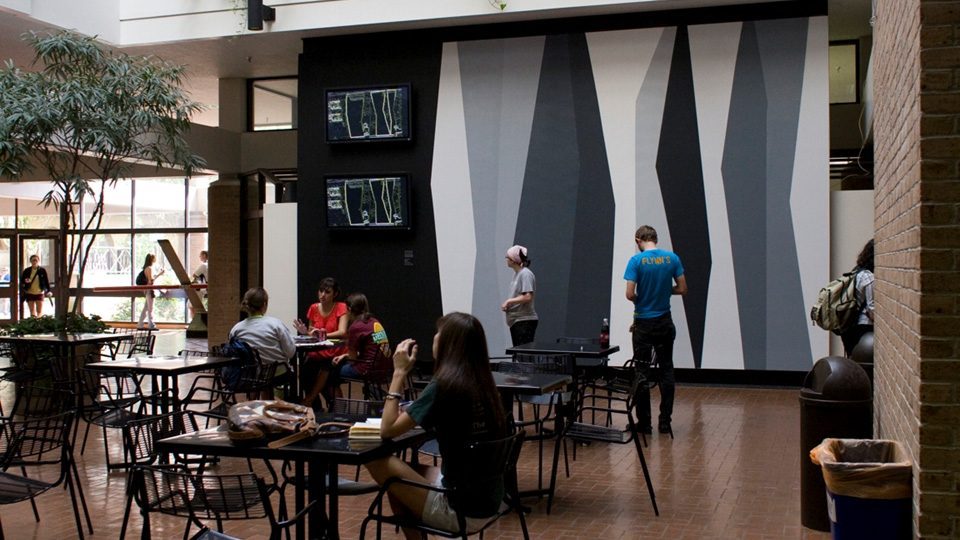
In 2006, a camera installed in the atrium of Louisiana State
University’s College of Art and Design to monitor a high-contrast mural
performed continuous blob detection, identifying regions of contrast
difference between the mural and pedestrians moving through the space.
Custom software converted those differences into real-time isolines
displayed on an adjacent monitor. As people moved through the atrium,
they became topographic events and their movement generated ephemeral
landforms.
The installation was called Thresholds, and what it revealed
was not what it was designed to demonstrate. The contour line is
landscape architecture’s foundational notation, yet the exhibition
exposed it as anything but fixed. Each isoline was a reading produced by
the interaction between a sensing instrument and a calibrated context.
Without the mural as datum, the isolines would have been noise. Change
the datum and a different landscape emerges. Designing the datum decides
in advance what the landscape will reveal. This is why the design of
sensing instruments and their contexts is not a technical layer applied
to landscape. It is integral to landscape formation itself.
Practice-Based Research
Figure 03_02Thresholds Installation, Louisiana State University College of Art and Design | Bradley Cantrell
This dissertation follows practice-based methods of research as that
is how this form of knowledge is produced, not by applying theory to
practice, but by building, deploying, and interrogating propositions in
material and spatial form.
The work develops a theoretical framework for landscape architecture
operating at the territorial scale. My creative practice and scholarship
are not case studies illustrating existing theory. They are the
foundation from which the theory is generated, tested, and revised. The
dissertation conforms to the structure of a practice-based PhD (Frayling
1993; MacLeod 2000). The written component functions as an epistemic
bridge between the practice and publicly verifiable knowledge, making
the practice itself legible as research. The six frameworks developed
across the chapters that follow, Multiple Intelligences,
Technogeographies of Sensing, Wetware, Generational Robotics, Coupled
Ecologies, and Reflexive Stewardship, emerged through this process.
Running through all six is the cultivant, a practitioner’s disposition
rather than a framework, the ongoing negotiation between designed
intention and biological agency in which maintenance is the primary
design act.
Frayling (1993) distinguishes research into, for, and through art and
design. This dissertation operates in the third category. Design is the
primary medium of inquiry, not an illustration of conclusions reached by
other means (Rust, Mottram, and Till 2007). Projects, models,
interfaces, and collaborations are where the research happens. The
written chapters situate that practice within the discourses of
landscape architecture, engineering, and environmental design (Deming
and Swaffield 2011; Swaffield and Deming 2011), providing the critical
interpretation through which the practice becomes legible as doctoral
contribution (MacLeod 2000).
“How is professional knowing like and unlike the kinds of knowledge presented in academic textbooks, scientific papers, and learned journals? In what sense, if any, is there intellectual rigor in professional practice?”
Donald Schön, The Reflective Practitioner (1983), opening questions
Figure 03_03Coastal Wetlands Restoration After Hurricane Katrina | NOAA (National Oceanic and Atmospheric Administration)
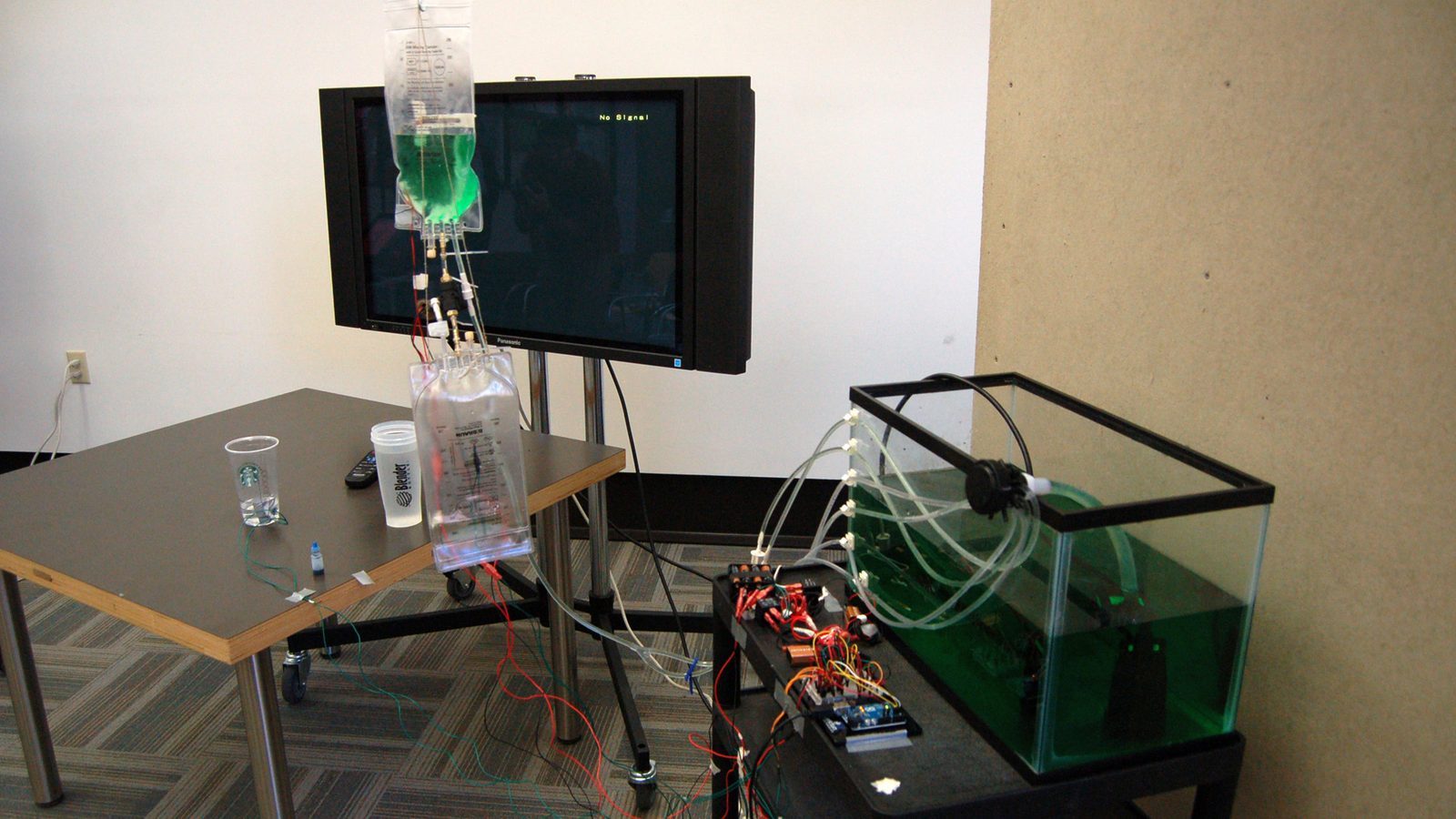
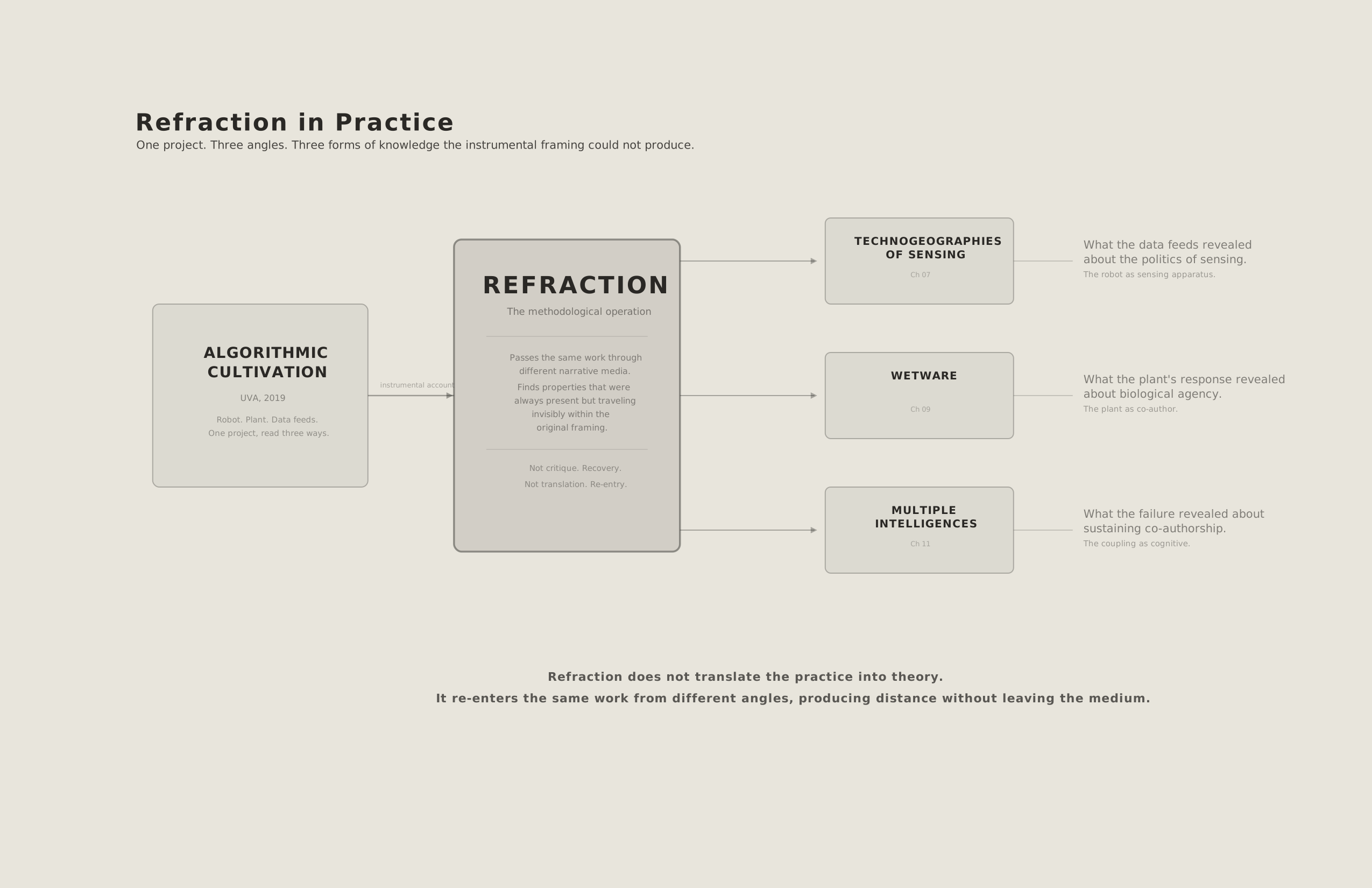
Several projects appear in more than one chapter. Algorithmic
Cultivation, the NEOM consultation, the UVA Geomorphology Lab,
Designing Autonomy, Prototyping the Bay, and
Indeterminate Futures each resurface across chapters because
the questions this dissertation asks are not answered by any single
project read from a single angle. Each chapter encounters the same
practice from a different vantage point, and what adaptive epistemology
reveals about the geomorphology table differs from what co-authorship
reveals about it, which differs from what the politics of sensing
reveals about it. This is not redundancy. It is purposeful and it is the
methodology.
Gilbert Ryle called it “systematic restatement” (Ryle 1954) where the
same object is described in different vocabularies, with each vocabulary
revealing what the others obscure. The practice operates the same way.
The reader who recognizes a project from an earlier chapter is not
re-reading. They are seeing it refracted with the same facets, but with
different light.
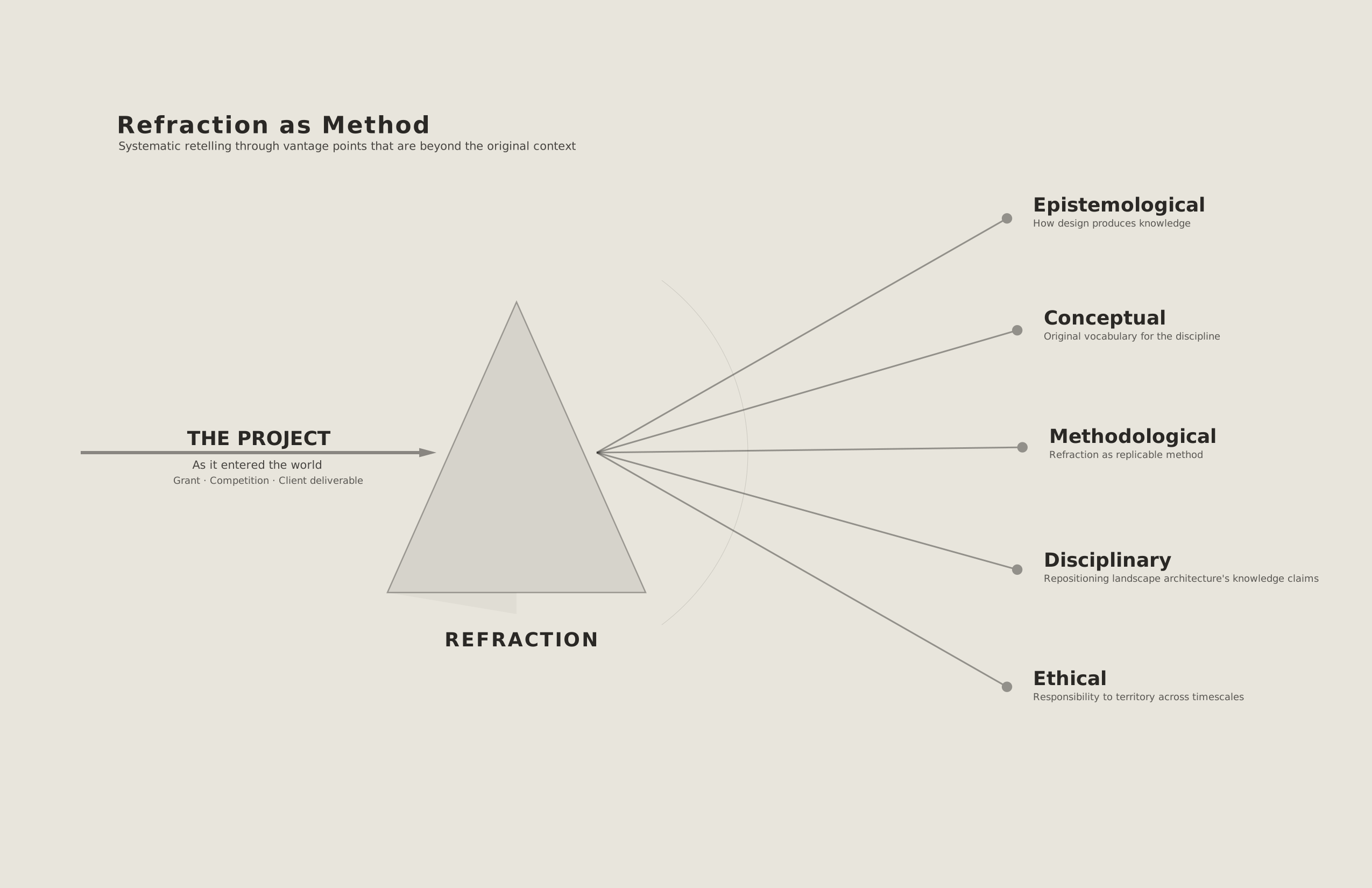
Refraction is the primary methodological contribution of this
dissertation. The term names a systematic practice of retelling, passing
the same body of work through different narrative media and reading each
project from vantage points that its instrumental contexts never
demanded. Grant narratives, book chapters, competition briefs, and
consulting deliverables each required a specific framing of the work,
what it does, why it matters, why it should be funded or built or
published. Those framings were true but partial. They served the
institutional contexts that made the work possible and in doing so they
constrained what could be seen.
Refraction does not replace those framings. It holds them alongside
new ones, and finds, in the gap between the instrumental account and the
doctoral retelling, properties of the work that were always present but
traveling invisibly within the original framing. This is not a method of
critique. It is a method of recovery.
Stamm identifies the structural problem that refraction solves. Any
practice research that insists on medial immanence, on remaining in the
medium of the practice itself, must simultaneously establish the medial
differential that makes reflection possible. Without distance from the
object, there is no reflection. But if distance is achieved by leaving
the material realm for discursive abstraction, the practitioner is
“researching oneself out of the work” (Stamm 2013, 37). Conceptual
reflection, however sophisticated, amounts to an alienation from the
reality of the work itself. What the practitioner should seek, Stamm
argues, is “to find a way of reflecting oneself deeper into the work, to
create an immanent ‘distance’ by further immersion into the work,
leveraging its depth dimensionality as the space to enter in order to
find the reflective medium” (Stamm 2013, 37).
Refraction is precisely this operation. It does not translate the
practice into theory. It re-enters the same projects from different
angles, creating the differential that reflection requires without
leaving the material medium. Each refraction produces distance, the gap
between what the instrumental framing made visible and what the new
angle reveals, but the distance is immanent. The practitioner is deeper
in the work, not farther from it. The PRS structure, described below,
provided the institutional mechanism through which this immanent
distance became systematic.
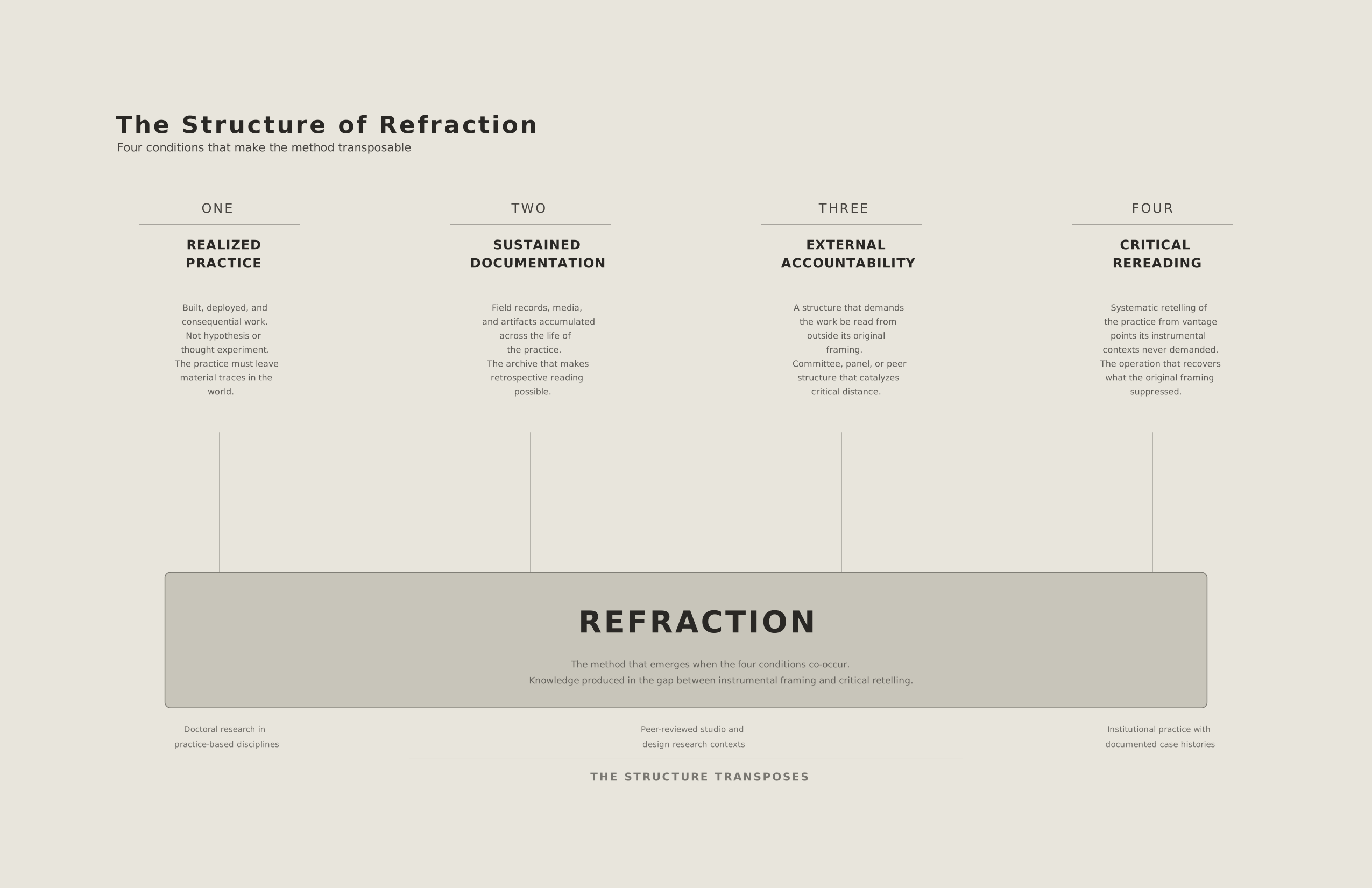
The Practice Research Symposia, six biannual sessions held between
2020 and 2023 with a seventh supplementary session, were the mechanism
through which refraction first became systematic and named. At each
session, the same body of work was presented to the committee and a
panel of external respondents. Each time, the story was told slightly
differently. The projects changed minimally. The angle of inquiry
changed. And from each new angle, properties emerged that no single
instrumental context could have made visible. The PRS did not produce
the method. It produced the conditions under which the method became
legible to the practitioner conducting it.
But refraction does not end with the PRS. The dissertation itself is
its continuation. Each chapter that follows encounters the practice from
a different theoretical vantage, adaptive epistemology, sensing
politics, multi-species authorship, generational autonomy, and each
encounter is a refraction. Projects reappear not because the argument
requires repetition but because the same body of work, seen from a new
angle, yields new knowledge. The reader who recognizes Algorithmic
Cultivation from an earlier chapter is not re-reading. They are
watching the method work.
Refraction is appropriate to this practice because the knowledge it
produces cannot be recovered by adding more data or conducting
additional fieldwork. It is already present in the work. What it
requires is a sustained, disciplined shift in the narrative medium
through which the work is examined. A practice that has been building,
deploying, and interrogating propositions across twenty years contains
more knowledge than any single framing has been able to name. The
doctoral inquiry creates the conditions in which that excess becomes
legible.
Richard Blythe’s written response to PRS 3 named this structure
directly. Where previous respondents had engaged the work’s content,
Blythe named its architecture. “I now see two registers to your PhD,” he
wrote, “and I think this is also what Claudia and others were pointing
at.” The first register was the experiment, the concrete project with
its own internal logic, its accumulated technical complexity, its
documentation and demonstrable outcomes. The second was the speculation,
the generative matrix of propositions from which the experiment had
emerged and which the experiment, in its institutional life, had
partially obscured. The instrumental framing, grant, competition,
consultation, had served the experiment. It had contained the
speculation. Refraction, as a systematic method, works precisely at that
boundary, recovering what the instrumental context suppressed not by
discarding the framing but by holding it alongside a new one. The
tension between the two registers is not a problem to be resolved. As
Blythe put it, the task was “to document both, to point to discoveries
in both, and to show how the combination of registers goes beyond
existing knowledge in the field.”
Paul Kelsch’s response at PRS 4 worked on the same territory from a
different angle. “It’s a pretty brave thing to do,” he said, “to say.
Here’s what I’ve been telling myself and my colleagues in the world
about what this work is about. And yet if I’m honest with myself it’s
only a certain amount truth and a certain amount lies and in the
combination of those two is where the interest is.” The phrase is
precise in a way that “refraction” itself struggles to be.
The instrumental framings were not wrong. They were partial, and the
partiality was functional. A grant narrative that told the full story of
what a project was epistemologically producing would not have been
funded. A competition brief that foregrounded knowledge production over
formal proposition would not have won. A consulting deliverable that led
with theoretical uncertainty would not have been commissioned. Each
framing performed the work’s legitimacy within the institutional context
that made the work possible. The partial framing is not a failure of
honesty but the condition of practice itself.
What refraction does is not expose the lie. It holds the partial
truth of the original framing alongside the fuller claim the doctoral
inquiry can now make, and it finds, in the gap between them, exactly
what Kelsch called “where the interest is.” The combination is not a
correction. It is the argument.
Marcelo Stamm’s intervention at PRS 6 named something the other
refractions had approached but not quite articulated. “What is it about
origins that is important,” he asked, “that all of a sudden
potentialities become apparent again, the virtual space of possibilities
that sits with the origins, with the inception space. Where there are
all sorts of vectors in which this could go.” The question was not about
the finished projects but about the moment before the instrumental
framing closes, the inception point where the work could still have gone
in any direction. What the PRS process had been doing, across six
sessions, was returning to that inception space repeatedly, not to
change what the work became but to recover what else it could have been
and to find, in those unrealized directions, the epistemological
structure the completed projects had made legible. The vectors were
always there. The doctoral inquiry named them.
Stamm’s published epistemological framework provides the
philosophical ground for what his PRS intervention performed. His
argument that practice research is fundamentally concerned with
“knowledge of singularities through immanent reflection,” and that the
most radical way to research singularities is by creating them,
“researching creation through creation” (Stamm 2013, 40), names the
epistemological status of the projects documented in this dissertation.
Each project is a singularity, a specific configuration of territory,
technology, and practitioner that cannot be replicated and whose
knowledge cannot be extracted without remainder into general principles.
Stamm insists that singularity does not compromise objectivity. What is
unique about a creative achievement is not subjective merely because the
conditions of its formation cannot be exhaustively reiterated (Stamm
2013, 39). The refraction method does not generalize from singularities.
It reads across them, finding in the pattern of unrepeatable instances
the epistemological structure that no single instance could have
revealed alone.
Figure 03_05VEG, Algae Processing Prototype, Responsive Systems Studio, Louisiana State University | Joshua Brooks and Kim Nguyen
Research through designing (Lenzholzer, Duchhart, and Koh 2013) names
the methodological backbone of this dissertation. Design generates
hypotheses in spatial and material form (Deming and Swaffield 2011), and
the artifacts produced through design embody theoretical propositions
that can be critiqued, compared, and tested across projects (Zimmerman,
Stolterman, and Forlizzi 2010). In this dissertation, that means when
the research asks how a landscape system behaves under a nascent
interaction, an alternative dredge logistics, a robotic diversion, an
ecological sensing network, the response is not analysis alone. It is
the design, construction, and testing of spatial and technical
propositions. Physical models, computational tools, sensing regimes, and
territorial design studies are the hypotheses. Their deployment and
evaluation are the primary research moves.
Not every question in the dissertation is addressed through design.
Where the problem is primarily descriptive or historical, the research
relies on textual analysis, archival reading, and argument. Each method
is employed where it is most productive. Design prototyping takes
priority where the question demands the reconfiguration of complex
eco-technical systems rather than the interpretation of existing
ones.
The political stakes of that epistemological claim became explicit at
the 2016 Venice Architecture Biennale in a collaboration with VGL. The
exhibition invited designers to develop branding packages for artificial
landmasses being physically constructed in the South China Sea through
real disputed territories and real geopolitical stakes. The work was
satirical, but what it revealed was not.
An artificial island becomes sovereign territory not when sand is
dredged and piled but when it appears on official maps, receives a name,
and circulates in media imagery. The sensing apparatus determines which
features become legible as landscape. The representational apparatus in
the exhibition determined which territorial claims become legible as
governance. In both cases, the instrument shapes what can be known, and
what can be known shapes what can be managed, governed, or manipulated.
You cannot separate the sediment from the image.
Case Study and
Comparative Project Analysis
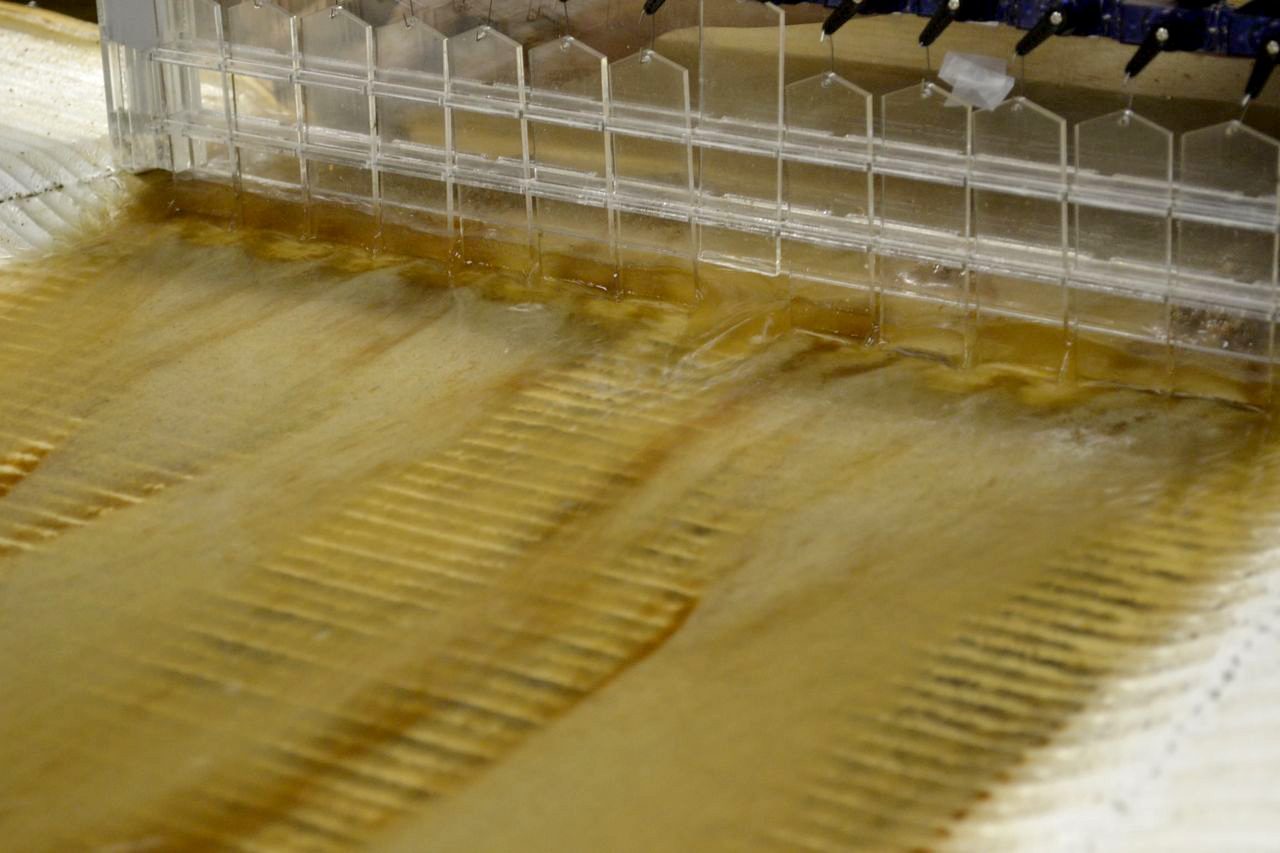
Figure 03_06Robotic Sediment Gates, Dredgefest 2014, Louisiana State University | Bradley Cantrell, Justine Holzman, Prentiss Darden, David MerlinFigure 03_07Refraction as Method Diagram | Bradley Cantrell
The dissertation relies on case-based research where the questions
demand contextual depth rather than variable control (Deming and
Swaffield 2011). River models at REAL and the UVA Geomorphology Lab,
pedagogical framings of coastal islands in the Chesapeake Bay,
consulting engagements for ecological infrastructures. These are not
illustrations of the frameworks. They are the sites in which questions
about adaptive epistemology, synthetic grounds, and Technogeographies
are defined and tested. Reading across project situations,
collaborations with research labs, design offices, and public agencies,
reveals how methods and concepts mutate or fail under different
institutional and territorial conditions. The cross-reading tests
whether the concepts developed here have value beyond any single site or
collaboration.
“Persons are identified and characterised not by the substantive attributes they carry into the life process, but by the kinds of paths they leave.”
Tim Ingold, The Perception of the Environment (2000)
Figure 03_08Aerial of a levee break on the Mississippi River in Missouri | FEMA (U.S. Federal Emergency Management Agency)
Physical
and Computational Modeling as Experimental Practice
The practice’s central questions are embedded in dynamic
environmental processes. Fluvial morphodynamics, sediment deposition and
erosion, biological community assembly, hydrologic performance. These
phenomena cannot be studied through static description. The research
engages them through geomorphological models and material experiments in
conversation with computational simulations and time-based
visualization.
Models in this context are not prediction tools. They are heuristic
instruments that produce design knowledge (Zimmerman, Forlizzi, and
Evenson 2007; Lenzholzer, Duchhart, and Koh 2013). They propose rather
than represent. A physical model of a deltaic system is a proposition
about which processes matter and how they interact, a prototype
environment in which overlapping feedback loops become visible and
negotiable.
At the Responsive Environments and Artifacts Lab at the Harvard
Graduate School of Design, a Kinect depth sensor mounted above a
geomorphology table, a basin of synthetic sediment and programmable
water flow, failed to resolve thin depositional layers. The instrument
could not see the sediment at a scale that mattered. The failure was the
finding, the sensing apparatus determined what could be known, and what
could be known determined what could be designed. Subsequent development
shifted to ultrasonic range finders and image analysis, not because the
Kinect was defective, but because its limits revealed the question that
needed to be asked differently.
This is what practice-based research produces that literature review
cannot, knowledge that emerges from friction with material dynamics. The
model is not a prediction engine. It is a site where the research
encounters resistance, and resistance generates understanding.
Bart Lootsma’s observation at PRS 5 carried a particular authority.
He opened by locating himself, a Dutch architectural theorist who had
grown up with a school magazine full of engineering simulations, and
whose uncle had planted 40 percent of the Netherlands with trees
according to succession plans. He understood, from both directions, what
it meant to work with systems that had their own logic. The
geomorphology tables, he said, could be understood as “material
computers,” devices in which “the computing is partly, of course,
already in there.” He was naming a tradition in which physical models
were understood to perform computation through material behavior, water
finding its own solution through sediment and slope. What the digital
sensing layer added was not computation but legibility, a way of reading
what the material had already worked out. Matias del Campo arrived at
the same term from a different direction. Where Lootsma came from
modeling cultures, del Campo came from assemblage theory, the idea that
“something like an assemblage is going on here between human
intervention and self-assembling.” It was in that assemblage quality
that he recognized the material computer, the convergence of human
intention and self-organizing matter into something that neither fully
controls. Two respondents, two frameworks, the same term. That
convergence was itself a refraction, two angles of inquiry arriving at
the same property that the original lab-equipment framing had kept
invisible.
Dana Cupkova pressed the modeling argument into territory the project
documentation alone had not reached. The issue of aesthetics, she
argued, does not arrive at the end of the process as an output or a
result. “It occurs within the model itself early on, the way you set up
the model.” The aesthetic ideology is built into the feedback structure
from the beginning, into the choice of what to sense, how to visualize,
what counts as a meaningful response. This observation reframes the
entire sensing apparatus. The instruments are not neutral recording
devices that produce aesthetic results downstream. They are aesthetic
arguments before the first reading is taken, decisions about what
matters embedded in the model’s architecture. The design of the
instrument is already the design of the knowledge it will produce.
Nicholas de Monchaux noted, almost in passing, that “the model as an
agent is really interesting, the model as an autonomous agent.” The
observation was brief but it named a trajectory the chapter had been
tracing without quite stating it directly. The model begins as
instrument, a tool for seeing. It becomes a site, a place where
knowledge is produced rather than confirmed. And then, as the practice
moves through responsivity toward autonomy, it begins to act, to make
decisions, to generate outcomes that exceed the designer’s
specification. The wildness creator is the model taken to its logical
conclusion, a system that has learned enough to operate without the
designer in the loop. De Monchaux saw that endpoint implied in the work
before the work had fully arrived there.
Models also function as shared experimental spaces. When designers,
engineers, and scientists work around the same geomorphology table or
computational simulation, they are negotiating what matters through a
common medium rather than across disciplinary translations. The model
does not merely test a hypothesis. It shapes which hypotheses become
thinkable. A specific model makes specific futures imaginable and others
begin to fall away. The practice’s contribution is not advancing
modeling techniques. It is making that shaping visible and
negotiable.
Kelsch’s most sustained intervention across PRS 4 and 6 returned
repeatedly to place. The models seemed abstract, he observed, and yet
they were tied to specific conditions, the Mississippi’s sediment loads,
the Atchafalaya spillway, the hydrology of the LA River. He quoted the
work back directly. “The areas act to nudge and guide the River system,”
and “the new riverbed is the product of interactions that guide outcomes
controlled within a range.” What struck him in those phrases was not the
technical claim but the value decision embedded in it. “How much
wildness can we tolerate?” he asked. “The sublime isn’t sublime when
it’s actual terror.” The geographic specificity of the modeling work was
not a limitation to be overcome but the site where those value decisions
become legible, where the interaction between designed intervention and
material system reveals what a practice actually believes about
indeterminacy, risk, and responsibility. Refraction does not replace
that specificity with abstraction. It makes visible the values the
specificity was carrying all along.
Figure 03_09Refraction in Practice Diagram | Bradley Cantrell
Communities
of Practice and Collaborative Inquiry
Figure 03_10Model Typologies from Practice Research Symposium 5 | Bradley Cantrell
The research is embedded in an ecology of collaboration among design
academics, professional firms, engineering and science labs, agencies,
and communities. The communities of practice framework (Lave and Wenger
1991; Wenger 1998) provides the lens for understanding how knowledge is
produced within these collaborations rather than translated between
actors. Working with geomorphologists in the lab, engineers in
professional offices, institutional staff in workshops, and peers in
design speculation produces different framings, different workflows, and
different standards of evidence. Not all collaborations are equally
generative. The dissertation privileges those in which I participate in
problem definition, experimentation, and reflection. It is more
selective about transactional engagements where design appears at the
end of an externally defined brief. Chapter 04 maps this ecology in
full.
Autoethnography and
Reflective Practice
Figure 03_11The Structure of Refraction Diagram | Bradley Cantrell
Many of the dissertation’s central concepts did not arrive fully
formed. Interface, Technogeographies, Wetware, adaptive epistemology
itself, each evolved across multiple projects, speculations, and
collaborations. To trace that evolution the dissertation employs
autoethnography as a complementary method (Ellis, Adams, and Bochner
2011; Adams, Holman Jones, and Ellis 2015). The accounts are not memoir.
They are expressed through project moments, decisions, and interactions,
and triangulated against collaborator testimony, project documentation,
and published outputs (Schön 1983; MacLeod 2000). Autoethnography is
most productive here when internal processes, skepticism, discomfort
with compromise, enthusiasm with prototyping, reveal the resistances and
catalysts that shaped how the practice developed.
“Persons are identified and characterised not by the substantive attributes they carry into the life process, but by the kinds of paths they leave.”
Tim Ingold, The Perception of the Environment (2000)
Figure 03_12POD MOD, Responsive Systems Studio, Louisiana State University | Charlie Pruitt and Brendan Dedon
Supporting
Methods: Literature, Documents, and Policy
The conceptual chapters synthesize work across landscape theory,
environmental humanities, science and technology studies, political
ecology, and media theory. This writing functions as scaffolding for the
practice rather than as the primary research driver. The central claims
are generated through engagement with projects and collaborations.
Scholarship provides the vocabulary through which those claims become
legible, not the source from which they are derived (MacLeod 2000).
The drawing project Failure (Drawing Codes, Pratt Institute,
2019; Chicago Architecture Biennial, 2020), in collaboration with Emma
Mendel, accumulated layers over months, code-generated urban forms
overlaid with ink spills, chemical transfers, erasures, collaborative
interventions. No layer was treated as permanent. A companion film
catalogued two centuries of environmental failures, catastrophic
industrial failures, levee collapses, and restoration projects abandoned
when the ecological behavior they were designed around failed to
materialize. These were predictive models that were invalidated by the
systems they claimed to describe.
The argument was direct. Complexity makes certain prediction
impossible. Accepting this does not require abandoning design. It
requires abandoning the assumption that design’s role is to prevent
failure and replacing it with the orientation Nassim Taleb calls
anti-fragility (Taleb 2012), designing systems that become stronger
through disruptions that cannot be predicted.
What these projects share, Thresholds, Branding
Islands, the labs, and Failure, is a commitment to
maintaining the capacity for ongoing learning, not delivering completed
knowledge, but establishing the conditions under which knowledge
continues to be produced. The following year, the lab’s geomorphology
table documentation was minted incrementally on the Tezos blockchain
throughout the Venice Architecture Biennale, a distributed archive built
on the premise that experiments conducted today may prove relevant to
questions not yet formulated.
That reorientation, developed through project-based research across
twenty years, is the argument this dissertation advances.
Why Some Methods Are Not
Central
This constellation of methods also defines what the dissertation does
not try to do. The primary unit of analysis is the project in its
milieu, not a statistical population. The work does not pursue
laboratory science in the narrow sense of controlled experiments on
single variables. It does not present a purely theoretical or historical
treatise developed in isolation from practice, concepts are held
accountable to their usefulness in the practice of landscape
architecture with design offices, engineers, scientists, agencies, and
communities. It does not propose a universal toolkit of methods, it
offers a repertoire of situated approaches that focus on design
research, collaborative modeling, case-based inquiry, communities of
practice, and autoethnographic reflection, which others may adapt to
their own ecologies of practice.
In short, the dissertation adopts methods that keep design,
collaboration, and dynamic environments at the center, and intentionally
sidelines methods that presuppose stable objects, fully controllable
variables, or disembodied observation.
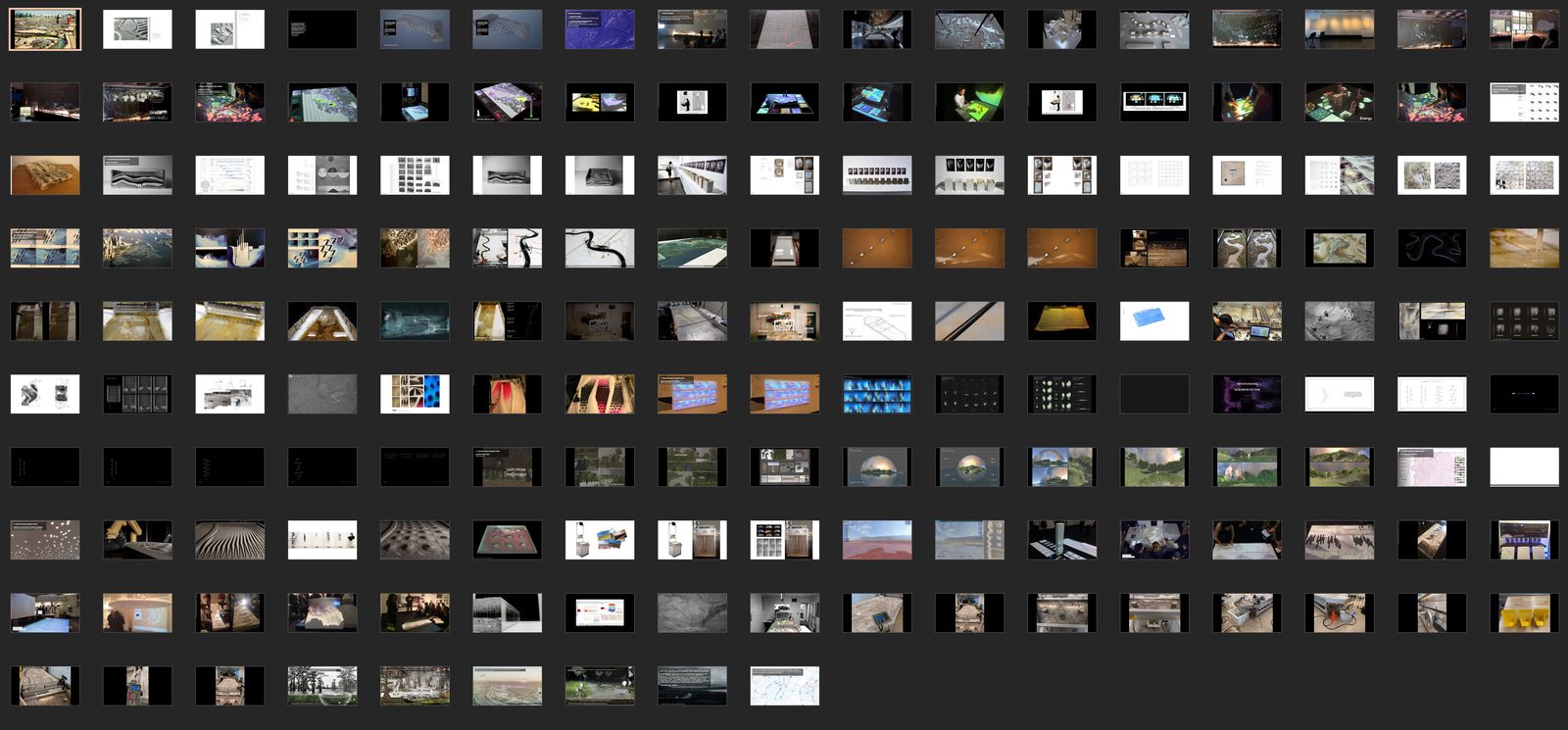
Full project documentation is gathered in Appendix A.
These are the questions the methodology is designed to hold open.
The chapters that follow do not resolve them, they demonstrate what it
looks like to work inside them, through the communities, tools, and
territories where the research was actually made.